Phishing Defense for Manufacturing: Protecting the Shop Floor and the Back Office
Most phishing awareness training was not written for a machinist, a line supervisor, or a shipping coordinator. It was written for office workers sitting at a desk, managing email all day, with time to read carefully before clicking.
Manufacturing employees operate in a different environment. They are moving between the floor and a shared terminal. They are responding to shift-related requests under time pressure. They receive emails from suppliers, logistics partners, scheduling systems, and internal management, and they need to act on those messages quickly to keep production moving.
That environment is exactly what makes phishing attacks on manufacturing employees so effective. Attackers know the pressure. They design their lures accordingly. And most manufacturing businesses have not trained their teams to recognize the specific scenarios they will actually encounter.
Why Phishing Hits Manufacturing Differently
General phishing training covers things like suspicious sender addresses, urgent requests, and mismatched links. That awareness matters. But it does not go far enough for manufacturing teams, because the phishing attempts targeting your employees look like the emails they already receive and act on every day.
A parts supplier is asking to confirm a delivery. A scheduling system notification about a shift change. An IT message about a software update for an ERP or MES system. A request from what appears to be a supervisor asking for a login confirmation.
These are the specific forms that spear phishing and social engineering take in manufacturing environments. Each one is designed to look like a routine request. Each one exploits the speed and trust that manufacturing workflows depend on.
The Manufacturing-Specific Phishing Scenarios Your Team Needs to Know
Fake vendor invoice and payment update requests
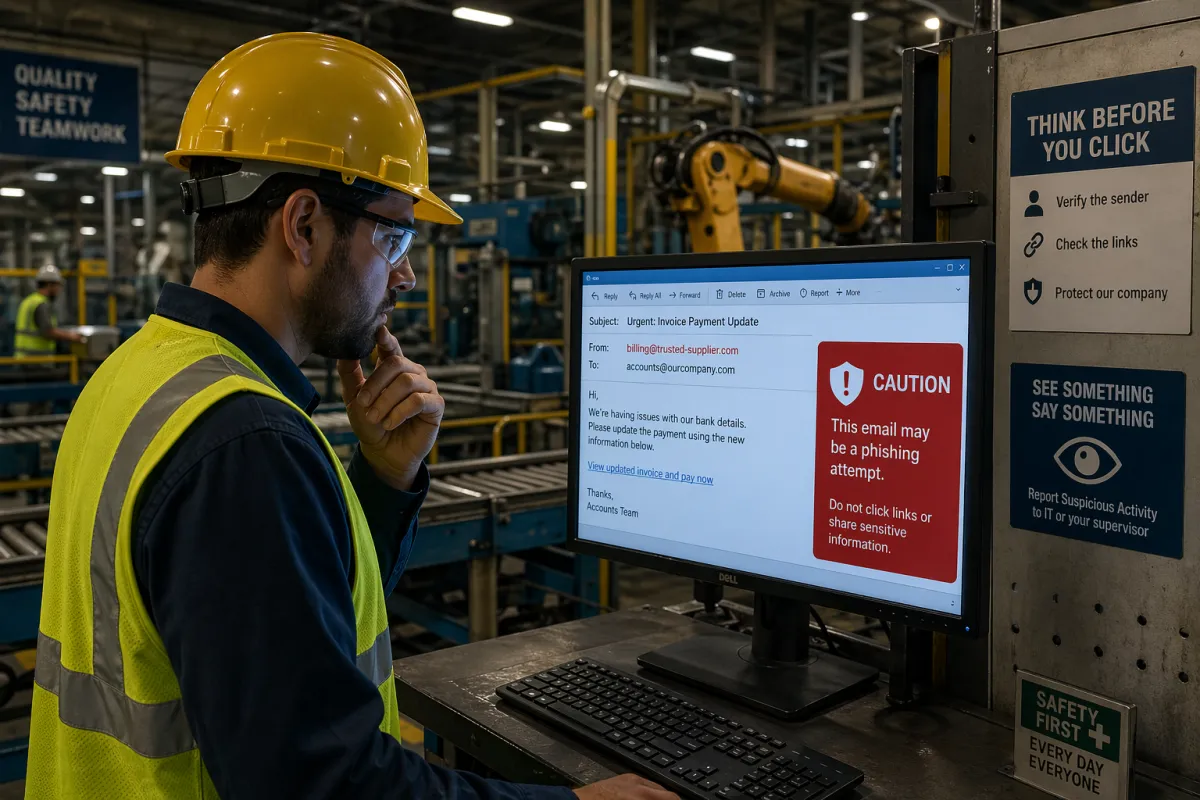
Your accounts payable team regularly receives invoices and payment instructions from suppliers. An attacker who has researched your supplier relationships can craft an email that mimics a real vendor's domain, references actual invoice numbers or product lines, and asks your team to update payment details or click a link to review a new invoice.
This is vendor impersonation, and it is one of the most financially damaging forms of phishing in manufacturing. The email looks like a routine procurement communication. The request seems like a normal step in the payment process. By the time someone realizes the payment went to a fraudulent account, the funds are gone.
Train your team: Payment account changes and new banking details from a vendor should always be verified by calling a known contact at that vendor directly, not by using contact information in the email itself.
ERP and MES login lures
Your ERP system, MES platform, or scheduling software likely sends automated notifications to employees. Attackers replicate the look of those system-generated messages to send fake login prompts. The email says something has changed in the system, a schedule was updated, or access needs to be reconfirmed. The link takes the employee to a convincing replica of the login page, and their credentials are captured the moment they enter them.
Credential theft through fake system login pages is one of the primary methods attackers use to gain entry into manufacturing company networks. Once they have credentials for your ERP or production scheduling system, they can move laterally through your network before anyone notices.
Train your team: System login requests should always be handled by navigating directly to the platform in a browser, not by clicking a link in an email. If the email claims something has changed in your account, log in independently and check.
Shift supervisor impersonation
This one is particularly effective on the floor. An employee receives a message that appears to come from their shift supervisor or plant manager, asking them to click a link, confirm some information, or handle a task urgently before the next shift starts. The name and tone match what the employee expects. The urgency matches the pace of the environment.
Spear phishing that impersonates internal authority figures works because employees are trained to respond promptly to supervisors. The social engineering here exploits workplace culture, not just technical naivety.
Train your team: Unusual or unexpected requests from supervisors sent via email should be confirmed verbally before acting. If the supervisor is in the building, a thirty-second conversation eliminates the risk.
IT support or software update requests
An email arrives claiming that a software update is required for the line management system, that an account has been flagged for review, or that IT needs credentials to resolve a network issue. In manufacturing environments where IT-related disruptions can halt production, these requests feel urgent, and employees are motivated to comply quickly.
Attackers use this urgency deliberately. Legitimate IT teams do not request credentials via email or ask employees to install software from a link sent in a message. That boundary is one of the most important things manufacturing employees can internalize.
Train your team: Your IT support team will never ask for passwords by email. If someone requests credentials or asks you to install something via a link, contact IT through a known channel before taking any action.
Shipping and logistics notification lures
Manufacturers with active inbound and outbound freight operations receive regular shipping notifications, tracking updates, and delivery confirmations. Attackers replicate these notifications, mimicking the formatting of carriers your team works with regularly. The embedded link goes to a credential harvesting page or delivers malware when the attachment is opened.
Because these emails arrive in volume and feel routine, employees often click without examining the sender or link closely.
Train your team: Tracking and shipping updates should be verified by visiting the carrier's website directly or checking within your logistics management system. Unexpected attachments in shipping emails should always be treated as suspicious.
How Can Manufacturing Companies Train Workers to Spot and Avoid Phishing Emails?
The answer is not a one-hour annual training session. It is short, regular, and scenario-based training that reflects the actual emails your team encounters.
Here is what an effective security awareness training approach for manufacturing looks like:
Keep sessions short and floor-friendly
A two-to-five-minute training module that can be completed at a shared terminal between shifts is more effective than a sixty-minute course that requires everyone to leave the floor. The content should be practical, not theoretical. Show a screenshot of what the fake vendor invoice looked like. Walk through the red flags in a real ERP login lure. Make it recognizable.
Run attack simulations
Phishing simulation platforms like KnowBe4 allow you to send controlled, safe phishing emails to your own employees and track who clicks. When someone clicks in a simulation, they receive immediate, low-pressure training rather than a disciplinary outcome. This builds real-world reflexes rather than just awareness of the concept.
Simulations should be tailored to the manufacturing context. A generic fake password reset is less useful than a simulated vendor invoice update or a fake ERP notification. The scenarios need to match what your team actually receives.
Create a simple, low-friction reporting process
If an employee suspects a phishing email, they need to be able to report it immediately and without concern that they are overreacting. A report button in the email client or a clear one-step process for flagging suspicious messages removes the hesitation that comes from not knowing the right thing to do.
Reinforce the right behaviors, not just the wrong ones
Training that focuses only on what employees did wrong when they clicked something creates anxiety and reduces willingness to report. Training that reinforces the process, checks the sender, hover before clicking, call to verify unusual requests, builds the habits that matter.
Extend training to both the floor and the back office
The accounts payable coordinator, the plant manager's assistant, and the purchasing team carry different risk profiles than floor operators, but all of them receive targeted phishing attempts. Training programs that cover the entire employee population, with content relevant to each role's specific exposure, are more effective than programs that focus on only one group.
The Technical Layer That Supports Training
Security awareness training reduces risk significantly. It does not eliminate it. Even well-trained employees are occasionally fooled, because phishing attacks continue to improve.
The technical defenses that work alongside training include email filtering that catches the majority of phishing attempts before they reach anyone's inbox, multi-factor authentication on every system that holds sensitive data so that stolen credentials alone are not enough to cause damage, and endpoint protection that detects and contains malicious activity even when a link does get clicked.
MFA is particularly important in manufacturing environments where ERP and production systems are high-value targets. A credential stolen through a fake login page becomes significantly less dangerous when a second authentication factor is required to actually use it.
Building a Defense That Works for Your Operation
The manufacturing environment has characteristics that generic cybersecurity programs do not account for. High-pressure workflows, shared terminals, shift-based communication patterns, and relationships with dozens of suppliers and logistics partners all create a specific attack surface.
An effective phishing defense for a manufacturing business addresses that surface directly: with training scenarios drawn from the manufacturing context, with simulations that reflect the actual emails your team receives, and with technical controls that limit the damage when something gets through.
If you want to start with a practical assessment of where your team stands today and what phishing scenarios are most relevant to your operation, reach out, and we can walk through it with you.