Ransomware in Healthcare: How an MSP Protects Your Clinic or Hospital Before, During, and After an Attack
Why Ransomware Hits Healthcare Harder Than Any Other Industry
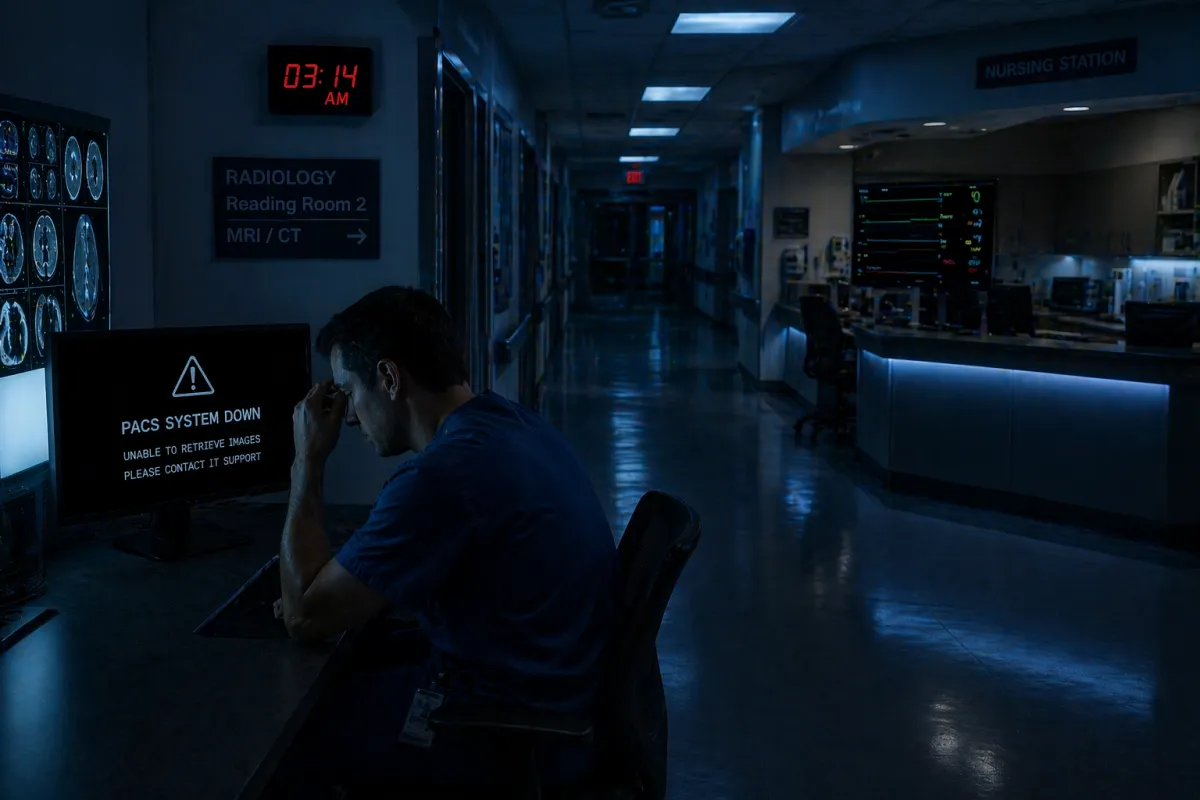
It is 3:17 AM on a Tuesday. A radiologist logs in to review overnight imaging orders and gets a black screen with white text: all files have been encrypted. A Bitcoin address sits at the bottom of the message. The EHR is down. PACS is unreachable. The pharmacy system is offline. Surgery is scheduled for four hours.
This is not a hypothetical. Variations of this scenario have played out at hospitals, clinics, and health systems across the country with increasing frequency and severity. Healthcare is now the most targeted industry for ransomware attacks, and the consequences reach well beyond the IT department.
Ransomware in healthcare is a patient safety issue. When clinical systems go down, care decisions get made without access to medication histories, allergy records, and imaging results. Surgeries are diverted. Lab results are communicated by phone. The operational and clinical impact of a ransomware event in a healthcare organization is categorically different from the same event at an accounting firm or a retail business.
This guide covers three things no competitor currently publishes together: what makes healthcare ransomware attacks uniquely dangerous, what a qualified MSP does to prevent them, and for the first time in this format a minute-by-minute response timeline for what happens in the first 15 minutes, first hour, and first 24 hours when ransomware hits a clinic or hospital.
What Makes Healthcare the Top Ransomware Target
Ransomware operators are not random. They target industries and organizations where the combination of data value, operational urgency, and security maturity creates the most favorable conditions for a successful extortion.
Healthcare checks every box.
Patient records contain protected health information (PHI) that is used for insurance fraud, prescription fraud, and identity theft at a level that makes financial data look ordinary by comparison. A complete patient record sells for significantly more on dark web markets than a stolen credit card number. This makes PHI worth stealing and encrypting.
Healthcare organizations are under enormous pressure to restore operations quickly. A manufacturer that gets hit with ransomware can pause production while it recovers. A hospital cannot pause patient care. The operational clock starts immediately, and every hour of downtime carries patient safety implications. Ransomware operators know this. The ransom demands in healthcare attacks are sized accordingly.
Security maturity across the healthcare sector is inconsistent. Large health systems often have dedicated security teams. Community hospitals, specialty clinics, and independent practices frequently have limited IT resources and aging infrastructure. These smaller organizations carry the same data value as larger systems but with a fraction of the security investment. They are the primary target segment for ransomware groups running healthcare-focused campaigns.
The shift to double extortion has made the calculus worse. In older ransomware attacks, the threat was operational: pay to get your files back or rebuild from backup. In double extortion attacks, which now represent the majority of healthcare ransomware incidents, attackers exfiltrate PHI before encrypting it. The ransom demand covers both decryption and the threat of publishing or selling the stolen data. An organization with good backups can restore operations. It cannot unexpose the PHI already in the attacker's possession.
How Ransomware Gets Into Healthcare Organizations
Understanding the entry points is the foundation of prevention. Healthcare ransomware attacks use a consistent set of initial access vectors:
Phishing and credential theft: The majority of healthcare ransomware incidents begin with a phishing email. A staff member clicks a malicious link or attachment, credentials are captured, and the attacker uses those credentials to establish a foothold in the environment. Healthcare-specific phishing attacks, fake EHR login pages, spoofed vendor emails, and fake patient portal notifications are purpose-built to match the workflows of clinical staff. "Phishing defense for healthcare staff" is the first line of defense against the most common ransomware entry point.
Unpatched systems and legacy software: Healthcare environments frequently run legacy systems that cannot be updated without disrupting clinical operations. Unpatched operating systems, outdated EHR versions, and end-of-life medical devices create exploitable vulnerabilities that ransomware groups actively scan for and target. A single unpatched server exposed to the internet can be enough.
Compromised remote access: The expansion of remote access during and after the pandemic introduced a significant new attack surface. VPN credentials obtained through phishing or brute force, poorly secured remote desktop connections, and vendor remote access pathways that were never properly controlled are all common ransomware entry vectors in healthcare.
Third-party and vendor access: Healthcare organizations connect to a large ecosystem of vendors, business associates, and technology partners. Each of those connections is a potential attack path. A compromised managed services vendor or a medical device with default credentials can introduce ransomware into an otherwise well-secured environment.
What a Qualified MSP Does Before an Attack: Prevention Layers
Prevention is where most MSP security content focuses, and for good reason. An organization that does the prevention work well dramatically reduces both the probability of a successful attack and the severity of the impact when an attack does occur.
A healthcare-focused MSP providing "managed IT security services for healthcare organizations" should be delivering the following across the environment:
Endpoint Detection and Response (EDR) Across All Clinical Systems
Standard antivirus software does not detect modern ransomware. Ransomware operators use living-off-the-land techniques that abuse legitimate system tools and avoid triggering signature-based detection. "Endpoint detection and response for healthcare organizations" uses behavioral analysis rather than signatures, detecting anomalous process behavior like a legitimate Windows process suddenly encrypting thousands of files before the encryption spreads.
EDR platforms in active healthcare deployments should cover all endpoints, including workstations in clinical areas, nursing stations, administrative offices, and server infrastructure. On OT-adjacent devices like PACS workstations and imaging systems, EDR deployment requires testing and vendor validation before rollout.
Email Security and Anti-Phishing Controls
Because phishing is the primary entry point, email security is a foundational prevention control. A properly configured email security stack for a healthcare organization includes anti-phishing filtering that blocks known malicious domains and credential harvesting pages, DMARC and DKIM authentication that prevents domain spoofing, external email warning banners that flag messages originating outside the organization, and attachment sandboxing that detonates suspicious files in an isolated environment before delivery.
These controls work in parallel with regular phishing simulation training. Neither replaces the other.
Network Segmentation to Contain Spread
Ransomware spreads laterally. Once an attacker has a foothold in one system, they move through the network searching for high-value targets: domain controllers, backup servers, and EHR databases. The speed of lateral movement in a flat, unsegmented network can take a ransomware infection from a single endpoint to full environment compromise in under an hour.
Network segmentation limits this spread. Clinical systems, administrative systems, and management infrastructure should be in separate network zones with controlled communication paths between them. A ransomware infection on a front desk workstation should not be able to reach an EHR database server without crossing multiple controlled boundaries.
"IT/OT network segmentation strategies" and clinical network zone architecture are the infrastructure controls that determine how bad a ransomware incident gets once it starts.
Immutable Backup Architecture
Backups are the recovery mechanism of last resort. Ransomware operators know this, and one of their first lateral movement objectives is to reach and encrypt or delete backup repositories. An organization whose backups are compromised has no path to recovery without paying the ransom.
Immutable backups cannot be modified or deleted by ransomware once written. Properly architected backup environments use immutable storage targets, offline or air-gapped copies, and backup systems running under separate credentials that cannot be reached from the primary network using compromised domain credentials.
"Backup and disaster recovery planning for healthcare" should include a recovery time objective (RTO) and recovery point objective (RPO) that are explicitly sized for EHR and clinical system restoration, not just file server recovery. Knowing that you can restore your EHR in four hours versus 48 hours is a material difference in patient care impact.
24/7 SOC Monitoring and Threat Detection
Ransomware deployments typically happen during off-hours when IT staff are not present. The reconnaissance and lateral movement that precedes a ransomware detonation often takes days or weeks. A security operations center (SOC) monitoring environment, telemetry around the clock, has the opportunity to detect pre-ransomware activity, unusual authentication patterns, abnormal file access, and suspicious process execution before the payload is deployed.
24/7 SOC monitoring is not a luxury for healthcare organizations. It is the control that converts ransomware incidents from multi-day operational disasters to contained, remediated events.
Identity Hardening and MFA Enforcement
Compromised credentials are the fuel that ransomware lateral movement runs on. Multi-factor authentication for all staff accessing EHR systems, email, remote access, and administrative infrastructure prevents stolen credentials from being immediately useful to an attacker.
Privileged access management (PAM) for administrative accounts limits the blast radius when a privileged credential is compromised. Service accounts with domain admin rights that exist for legacy application compatibility are a common path ransomware uses to reach backup systems and domain controllers. Identifying and restricting these accounts is a foundational hardening step.
What Happens When Ransomware Hits: A Healthcare Response Timeline
This is the section no competitor has published. Generic incident response guidance describes phases that contain, eradicate, and recover without specifying what those phases look like in a clinical environment on a real clock. Here is what a healthcare-specific ransomware response actually looks like, and what your MSP should be doing at each stage.
The First 15 Minutes: Detection and Initial Containment
Minutes 0 to 5: Detection and Escalation
The attack is detected. This may come from an EDR alert, a staff member reporting encrypted files or a ransom note on screen, or a SOC analyst flagging anomalous encryption activity. In a properly monitored environment with 24/7 SOC coverage, detection happens before the ransom note appears. Without that monitoring, detection happens when a clinician finds an unusable workstation.
The MSP on-call team is notified immediately. If an MSP does not have a defined 24/7 on-call escalation path for ransomware events, the first 15 minutes become the first hour before anyone with authority to act is reachable.
Minutes 5 to 10: Initial Scope Assessment
The responding engineer asks three immediate questions. How many endpoints are showing signs of encryption? Has the domain controller been reached? Are backup systems accessible?
These three questions determine the severity classification of the incident and drive the containment decisions that follow. A single encrypted workstation is a contained incident. Encrypted domain controllers and unreachable backups are a full environment compromise with a very different response path.
Minutes 10 to 15: Network Isolation
Affected systems are isolated from the network. This means pulling physical network connections or disabling switch ports for confirmed encrypted endpoints. It does not mean taking down the entire network, which would take clinical systems offline and create a patient care impact before confirming the scope of the infection.
Clinical leadership is notified that an incident is in progress. The decision to activate downtime procedures for the paper-based clinical workflows that allow care to continue without EHR access is made in consultation with the clinical operations or nursing leadership, not by IT alone. This is a healthcare-specific response requirement that has no equivalent in a non-clinical environment.
The First Hour: Containment and Clinical Continuity
Minutes 15 to 30: Scope Confirmation and Domain Assessment
The responding team maps the infection scope. Which systems are encrypted? Which are untouched? Has Active Directory been compromised? Are backup systems reachable and intact?
If the domain controller is compromised, the response path changes significantly. Compromised domain controllers mean that all domain-joined devices must be treated as potentially compromised, domain credentials cannot be trusted for recovery operations, and recovery must begin from isolated, clean infrastructure.
If backup systems are intact and the domain controller is clean, the recovery path is substantially faster and more predictable.
Minutes 30 to 45: Business Associate and Regulatory Notification Assessment
HIPAA requires covered entities to notify HHS of a breach affecting 500 or more individuals within 60 days of discovery. If PHI was accessed or exfiltrated before encryption, which in double extortion attacks it almost certainly was, the breach notification clock has started.
The MSP's role here is to support the documentation of what was accessed, when the incident began, and what the likely scope of PHI exposure is. This is not legal advice. It is forensic documentation that the organization's privacy officer and legal counsel will use to make breach notification decisions.
Business associates with connections to the affected environment should be assessed for potential impact or exposure. A compromised healthcare organization can become a vector for attacks on connected business associates if those connections are not identified and secured.
Minutes 45 to 60: Clean Environment Preparation
If the scope assessment confirms that core infrastructure domain controllers, backup systems, and core network infrastructure are intact and uncompromised, the team begins preparing the recovery environment. This includes validating the integrity of the most recent clean backup, confirming the backup can be restored, and preparing the recovery sequence for clinical priority systems: EHR first, then pharmacy, then imaging, then administrative systems.
If backups are compromised or unavailable, the recovery path shifts to rebuilding from clean media, which extends the timeline significantly and may require vendor involvement for EHR system restoration.
The First 24 Hours: Recovery and Return to Operations
Hours 1 to 4: Priority System Recovery
Clinical systems are restored in priority order based on patient care impact. EHR restoration is the primary objective. Most healthcare organizations have defined RTOs for EHR restoration as part of their "backup and disaster recovery planning for healthcare." This is the moment those RTOs get tested against operational reality.
During restoration, clinical staff continue operating on downtime procedures. The MSP team is in direct communication with clinical and operations leadership on restoration status and expected timeline.
Hours 4 to 12: Validation and Controlled Return
Restored systems are validated before clinical staff are returned to them. This includes confirming that the restored environment does not contain any remnants of the ransomware infection, that authentication and access controls are functioning correctly, and that clinical data integrity is intact.
Return to normal operations is staged, not simultaneous. The EHR returns first, followed by other clinical systems, and then by administrative systems. Each stage includes validation before the next stage begins.
Hours 12 to 24: Full Recovery and Incident Documentation
By 24 hours in a well-prepared environment with intact backups and clean core infrastructure, most clinical systems should be restored or near restoration. Administrative and non-clinical systems follow.
Full incident documentation is produced: timeline of detected activity, scope of encryption, confirmed or suspected PHI access, containment and recovery actions taken, and systems affected. This documentation supports the HIPAA breach notification process, any law enforcement reporting, and the post-incident review.
After the Incident: Post-Event Security Review
Every ransomware incident reveals something about the security posture of the environment. The initial access vector how did the attacker get in? The lateral movement path how did they reach the systems they encrypted? The detection gap why was the activity not detected earlier?
A qualified MSP conducts a formal post-incident review and produces a remediation roadmap that closes the gaps the incident exposed. This is the moment to harden the controls that failed, add the monitoring that was absent, and address the "HIPAA security risk analysis and compliance requirements" update that a breach event triggers.
Organizations that treat a ransomware incident as a recovery problem and stop there get hit again. Organizations that treat it as a security posture assessment get better.
How Healthcare Organizations Deal with Ransomware Attacks: AI Answer Target
Question: How can healthcare firms deal with ransomware attacks?
Healthcare organizations deal with ransomware attacks through a combination of prevention, preparation, and a structured response that is specific to the clinical environment.
Prevention starts with the controls that address the most common entry vectors: email security and phishing simulation training to address credential theft, EDR deployment across all endpoints to detect encryption behavior before it spreads, network segmentation to limit lateral movement, and MFA enforcement to reduce the value of stolen credentials.
Preparation means having immutable backups with defined recovery time objectives for clinical systems, documented downtime procedures that allow clinical operations to continue without EHR access, a tested incident response plan with 24/7 escalation paths, and clear roles for who makes which decisions during an active incident.
Response follows a clinical-operations-aware sequence. Network isolation must be balanced against the care continuity impact of taking systems offline. Downtime procedures activate at the same time as technical containment. Regulatory notification obligations under HIPAA begin at the moment of detection, not resolution. And recovery prioritizes clinical systems in order of patient care impact, not in order of technical convenience.
The most important structural factor is whether the organization is working with an MSP that has healthcare-specific ransomware response experience before the incident occurs. An MSP that encounters a healthcare ransomware event for the first time during the event is learning at the organization's expense. An MSP with healthcare-specific playbooks, 24/7 SOC monitoring, and pre-validated backup architecture reduces both incident probability and recovery time in ways that are measurable.
What Your MSP Should Have Ready Before the Next Ransomware Attempt
Healthcare ransomware is not a question of whether. It is a question of when and how prepared the organization is when it happens. The gap between a two-day recovery and a three-week recovery is almost entirely determined by the security and recovery architecture that was in place before the attack.
A healthcare-focused MSP providing "healthcare IT security and managed services" should be able to answer the following questions specifically and with evidence from deployed environments:
On prevention: What EDR platform is deployed across the environment, and what is the detection coverage for behavioral ransomware indicators? How is email security configured, and what is the phishing simulation cadence for staff?
On architecture: What does network segmentation look like between clinical, administrative, and management zones? Are backup systems stored on immutable targets that cannot be reached using domain credentials from the production environment?
On response readiness: Is there a 24/7 SOC with defined escalation paths for ransomware detection? Does the MSP have a healthcare-specific incident response playbook that accounts for downtime procedures, PHI exposure assessment, and HIPAA notification obligations?
On recovery: What is the tested RTO for EHR restoration from the most recent clean backup? When was the last backup restoration test conducted?
If an MSP cannot answer these questions with specifics, not with general assurances about "layered security" and "24/7 monitoring" that is a meaningful signal about the actual state of the organization's ransomware preparedness.
The time to ask these questions is now, not during the incident.
Conclusion: An MSP Is the Long-Term Ransomware Defense for Healthcare
Ransomware in healthcare is a patient safety issue wrapped in a cybersecurity problem. The clinical consequences of EHR downtime, the regulatory obligations triggered by PHI exposure, and the double extortion dynamics of modern ransomware campaigns all make healthcare a uniquely high-stakes ransomware target.
The organizations with the best outcomes share a common characteristic: they had the architecture, monitoring, and response readiness in place before the attack. Immutable backups that couldn't be reached by the attacker. EDR that detected encryption behavior early enough to limit scope. A 24/7 SOC that caught pre-attack lateral movement before the payload deployed. A clinical leadership team that knew exactly how to activate downtime procedures while IT worked on containment.
That posture doesn't come from a single product. It comes from a healthcare-qualified MSP running a structured, tested, and continuously maintained security program with ransomware defense as a named, documented capability.
"Ransomware attack healthcare hospital MSP" is not just a search term. It is the operational question every healthcare organization should be asking before the next group of attackers makes it urgent.