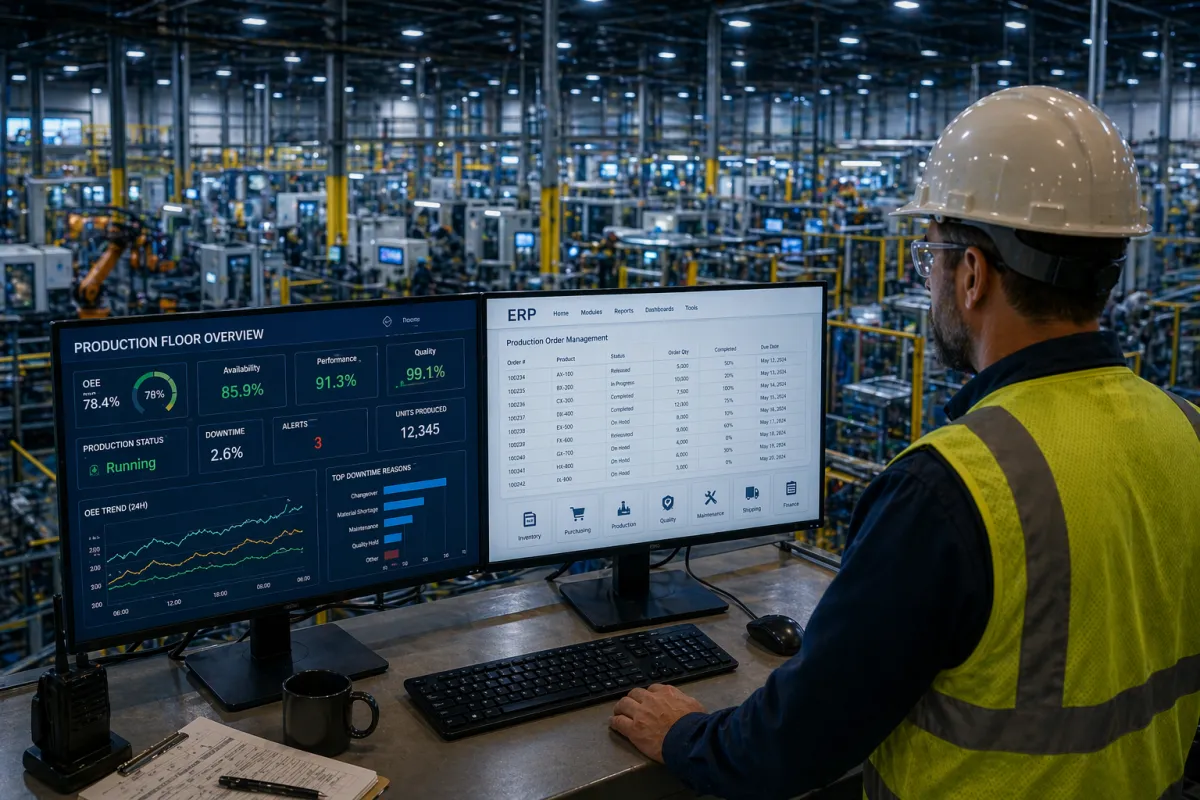
MES and ERP Integration: How MSPs Close the Gap Between the Shop Floor and the Business Office
The Gap Between the Shop Floor and the Business Office Is a Data Architecture Problem
In most manufacturing facilities, two separate systems govern two separate realities.
The ERP system governs the business reality: production orders, inventory positions, customer commitments, purchase orders, and financial results. It is the system of record for planning, finance, and supply chain.
The MES governs the shop floor reality: what is actually running on each line right now, what work orders are in progress, what the cycle time on that press has been for the last four hours, and whether the quality check on the last batch passed or failed.
When these two systems do not talk to each other, the gap between them is filled by manual data entry, shift-end reports typed from handwritten notes, and production managers walking the floor to reconcile what the ERP says should be happening with what the MES says is actually happening. That manual reconciliation work does not add any value to production. It consumes supervisor time, introduces transcription errors, and means that the business office is always operating on data that is hours or days behind the shop floor.
MES and ERP integration closes that gap. When it is done correctly, a completed work order on the shop floor automatically updates inventory in the ERP. A quality hold logged in the MES automatically flags the associated production order in the ERP. A production schedule change in the ERP immediately appears as updated work orders in the MES. The two systems share a single operational reality instead of maintaining two separate ones.
Getting from disconnected systems to integrated systems is an IT infrastructure and architecture project. It is also one of the highest-value projects a manufacturing-focused MSP can deliver, and the one that requires the most specific technical knowledge to execute without creating new problems in the process.
Why MES and ERP Integration Is More Complex Than It Looks
Every ERP vendor and every MES vendor has a marketing page about integration. The reality of executing a specific MES-to-ERP integration in a production environment is considerably more complex than the marketing language suggests.
The complexity comes from three sources.
First, MES and ERP systems were designed by different vendors for different purposes with different data models. A work order in the ERP has a structure and a set of fields defined by the ERP vendor. A production order in the MES has a structure and a set of fields defined by the MES vendor. Connecting them requires mapping the data from one structure to the other, handling the fields that exist in one system but not the other, and managing the differences in how each system defines things like routing steps, work centers, and quality attributes.
Second, integration must handle real-time and batch data differently. Some data flows need to be near-real-time: a quality hold logged in the MES should block the associated ERP order immediately, not after a nightly batch sync. Other data flows are appropriate for scheduled batch transfer: daily production summaries, end-of-shift labor records, and completed work order confirmations can sync on a scheduled basis without affecting operations. Designing the right sync cadence for each data flow requires understanding both the operational urgency of the data and the performance impact of sync frequency on both systems.
Third, production environments cannot tolerate integration failures that stop operations. An integration failure in a back-office context, a failed sync between a CRM and a marketing platform, is an inconvenience. An integration failure that prevents work orders from appearing in the MES, or that leaves a production order in a blocked state in the ERP because the completion confirmation from the MES never arrived, stops production or requires manual intervention to clear. Integration architecture in manufacturing must include error handling, alerting, and fallback procedures that are designed from the start, not added after the first failure.
The Three Integration Architecture Options: API, Middleware, and Direct Database
This is the technical explainer that no MSP content currently publishes. There are three distinct integration architecture approaches for connecting MES and ERP, each with different tradeoffs for manufacturing environments.
Option 1: Direct API Integration
In API-based integration, the MES and ERP communicate directly through each system's published API. When a work order is completed in the MES, the MES sends an API call to the ERP to post the production confirmation. When a new production order is created in the ERP, the ERP sends an API call to the MES to create the corresponding work order.
Advantages: Direct API integration is the cleanest architecture when both systems have well-documented, stable APIs. It has the fewest moving parts, the lowest latency for real-time data flows, and the lowest ongoing infrastructure cost.
Limitations: Not all MES and ERP systems expose complete APIs for all the transactions a full integration requires. Older MES platforms may have limited API coverage for shop floor transactions. ERP systems in the mid-market range vary significantly in API completeness. When a required transaction is not available through the API, direct API integration requires workarounds that add complexity and maintenance burden.
Best suited for: Environments where both the MES and ERP are modern platforms with well-documented REST APIs and where the integration scope is limited to a defined set of standard transactions.
Option 2: Middleware Integration Platform
Middleware integration platforms, MuleSoft, Dell Boomi, Azure Integration Services, and similar tools, sit between the MES and ERP as a dedicated integration layer. Data flows from the MES to the middleware platform, the platform transforms it into the format the ERP expects, and then delivers it to the ERP. The same process runs in the reverse direction.
Advantages: Middleware platforms handle the data mapping and transformation between different data models more cleanly than direct API integration. They provide centralized monitoring of all data flows, built-in error handling and retry logic, and the ability to add new integration points without modifying the connected systems. For manufacturers with multiple systems that all need to exchange data, ERP, MES, quality management, production historian, and supplier portals, a middleware platform provides a single integration hub rather than a web of point-to-point connections.
Limitations: Middleware platforms add infrastructure cost and operational complexity. They require configuration expertise to set up and ongoing monitoring to maintain. A middleware integration that is deployed and forgotten accumulates mapping errors and version incompatibilities as the connected systems are updated.
Best suited for: Environments with complex integration requirements spanning multiple systems, or where the MES and ERP have different data models that require significant transformation before data can be exchanged.
Option 3: Direct Database Integration
In direct database integration, a custom process reads directly from the database of one system and writes directly to the database of the other. A SQL job runs on a schedule, reads completed production orders from the MES database, and inserts the corresponding confirmation records into the ERP database.
Advantages: Direct database integration can be implemented quickly for specific, well-defined data flows. It works even when a system has no API and no middleware connector.
Limitations: Direct database integration bypasses the application layer of both systems, which means it bypasses the business logic, validation rules, and audit trails that the application enforces. Writing directly to an ERP database can create records that the ERP application cannot process correctly because they do not conform to the constraints the application expects. ERP vendors do not support direct database writes and will disclaim support for any issues that arise from them. This approach also creates a hard dependency on the specific database schema of each system, a schema that can change with any application update, breaking the integration without warning.
Best suited for: Narrow, low-risk data flows where no API or middleware option is available, implemented with full awareness of the risks and with explicit vendor acknowledgment of the approach. Not recommended as a primary integration architecture for production-critical data flows.
How a Managed IT Provider Helps Manufacturers Integrate MES With ERP
A managed IT provider with manufacturing system experience contributes to MES and ERP integration in four specific ways that a general system integrator or a software vendor's professional services team typically does not.
Integration architecture selection based on the specific systems in the environment: The right integration architecture depends on the API capabilities of the specific MES and ERP versions in use, the complexity of the data flows required, and the operational risk tolerance of the production environment. An MSP that has deployed integrations across multiple MES and ERP platform combinations has the reference experience to make this selection correctly, rather than defaulting to the architecture the software vendor recommends, regardless of fit.
Production continuity design:
Integration projects that touch live production systems carry operational risk at every stage, during development when test environments need to be synchronized with production data, during testing when integration errors can affect production records, and during cutover when the new integration replaces whatever manual process or legacy connection existed before. An MSP experienced with "MES ERP integration manufacturing IT support" builds the integration project plan around production continuity requirements, not around what is most convenient for the integration project.
Ongoing monitoring and error management:
MES and ERP integrations do not stay healthy without active monitoring. Data flow failures, API version changes after system updates, and mapping errors introduced by configuration changes in either system all require detection and remediation. An MSP managing the integration on an ongoing basis monitors data flow health, responds to failure alerts, and manages the integration through system updates that could break connectivity.
Integration as part of the broader manufacturing IT environment:
MES and ERP integration does not exist in isolation. The integration traffic runs across the same network infrastructure that production systems depend on. The ERP database that receives production confirmations is the same database covered by the backup architecture. The MES that sends work order data is in the same monitored environment as the SCADA systems and production control network. "Managed IT support for MES and ERP integration in manufacturing," delivered by the same MSP managing the broader environment, produces better outcomes than a standalone integration project managed by a vendor with no visibility into the infrastructure context.
Conclusion: Integration Closes the Gap That Manual Reconciliation Was Hiding
The manual reconciliation work that fills the gap between a disconnected MES and ERP is not a process problem. It is an architecture problem. The supervisors entering shift-end production data into ERP manually are doing work that the integration should do automatically, work that produces no operational value, introduces errors, and means the business is always making decisions on data that the shop floor corrected hours ago.
The integration architecture options covered in this guide, direct API, middleware, and direct database, each have legitimate use cases. The right choice depends on the specific systems, the integration scope, and the operational risk tolerance of the production environment. Making that choice correctly and executing it without production disruption is where "manufacturing IT security and managed services" expertise translates directly into operational and business value.