Managed Network Services for Multi-Site Manufacturers: Keeping Every Plant Connected and Secure
Why Multi-Site Manufacturing Networks Fail Differently Than Single-Location IT
A manufacturer with one facility has one set of network problems. A manufacturer with four facilities has four sets of network problems, plus the problems that exist only because those facilities need to talk to each other.
Multi-site manufacturing networks fail in ways that single-location IT environments do not. A circuit outage at a remote plant cuts that facility off from ERP, from centralized quality systems, from shared file infrastructure, and from the IT team that manages all of it. That team is usually at a headquarters location that is suddenly unreachable. A misconfigured firewall at one site can expose the entire WAN. A production floor network at a new facility that is connected to headquarters without proper segmentation becomes an attack path into every other location on the same network.
The manufacturers that manage this well do not do it with an internal IT generalist who visits each plant twice a year and an ISP-provided router at each location. They do it with a managed network services multi-site manufacturing partner that designs, operates, and monitors the entire environment as a single coherent architecture, with site-specific security requirements built in from the start.
This guide covers the specific network architecture challenges multi-site manufacturers face, the connectivity and security design that addresses them, and how an MSP manages day-to-day operations across every location.
The Four Network Challenges That Are Specific to Multi-Site Manufacturing
Before addressing solutions, the problems deserve a clear description. These are the four challenges that appear consistently in multi-site manufacturing environments, and that generic IT advice does not adequately address.
Challenge 1: ERP and Centralized System Access Across All Sites
Most mid-market manufacturers run their ERP, quality management system, and centralized file infrastructure from a primary data center or headquarters location. Every remote plant depends on reliable, low-latency connectivity to that central hub to run production planning, process work orders, submit quality records, and access engineering documentation.
When the WAN link between a remote plant and headquarters degrades or fails, every one of those functions stops. Production planning runs off local memory and paper. Quality records back up. Shipping documentation cannot be generated. The dependency on centralized systems means that network reliability is not an IT issue. It is a production operations issue.
Challenge 2: Different Security Requirements at Each Site
A headquarters office and a production plant floor have fundamentally different security requirements. The office network hosts general business workstations, an ERP application layer, shared file servers, and email infrastructure. The production floor network hosts PLCs, HMIs, SCADA systems, and industrial control equipment that use protocols and have security constraints that standard IT network management tools do not handle correctly.
In a multi-site manufacturing environment, these different security zones need to be maintained consistently across every location. A remote plant that connects its production floor directly to the site's WAN without proper segmentation from the IT network exposes that OT environment to every threat that reaches any other site on the WAN. Consistent zone architecture across sites is a multi-site problem that does not exist in single-location environments.
Challenge 3: Remote IT Management Without On-Site Staff
Most remote manufacturing plants do not have dedicated on-site IT staff. When a network device fails, a server becomes unreachable, or a connectivity problem develops, the resolution depends on an IT team at headquarters or at a managed network services provider, not on the plant floor.
Remote management of network infrastructure requires more than an RMM agent on a server. It requires out-of-band management interfaces on switches and firewalls so that devices that lose their primary network connection are still accessible for remote diagnosis and reconfiguration. Without this infrastructure, a failed firewall at a remote plant is unreachable until someone drives to the facility.
Challenge 4: Bandwidth Management Across Production Shifts
Manufacturing facilities do not use bandwidth the way offices do. A production shift that runs ERP transactions, MES updates, quality system submissions, and engineering file transfers simultaneously during a shift change creates bandwidth demand patterns that are different from office traffic. Remote plants sharing a WAN connection with headquarters can experience ERP response degradation during peak production periods if bandwidth management and traffic prioritization are not explicitly configured.
Unmanaged bandwidth contention between production-critical ERP traffic and lower-priority traffic, such as software updates, backup replication, and video conferencing, directly affects production floor responsiveness in ways that manufacturing staff notice even when IT teams do not.
The Multi-Site Manufacturing Network Architecture
This is the design framework that no competitor currently publishes. A multi-site manufacturing network built for production reliability and consistent security has four defined layers.
Layer 1: Site Connectivity with SD-WAN
The WAN technology decision determines the reliability, flexibility, and cost structure of the entire multi-site environment. The two primary options are MPLS (Multiprotocol Label Switching) and SD-WAN (Software-Defined Wide Area Network).
MPLS provides dedicated, provider-managed circuits with guaranteed bandwidth and low latency. It is reliable and predictable. It is also expensive, inflexible on bandwidth changes, and dependent on a single provider's infrastructure.
SD-WAN uses multiple lower-cost internet circuits, typically broadband plus LTE backup, combined with software-defined traffic management that routes production-critical traffic intelligently across available paths. For managed network services in multi-site manufacturing environments, SD-WAN provides WAN redundancy that MPLS typically does not. If the primary circuit at a remote plant fails, SD-WAN automatically routes traffic over the backup circuit without manual intervention and usually without the users noticing.
The practical recommendation for most mid-market multi-site manufacturers is SD-WAN with application-aware traffic prioritization. ERP and MES traffic is prioritized over backup replication and update traffic. Each site has a primary circuit and an LTE or secondary broadband failover. The SD-WAN overlay provides centralized visibility into all site connectivity from a single management interface.
Layer 2: Consistent Security Zone Design at Every Site
Every site in the network needs the same zone architecture, configured consistently. This means three defined zones at each location.
The IT zone contains business workstations, ERP application access, file services, and standard office infrastructure. This zone has outbound internet access through the site firewall and WAN connectivity to headquarters.
The OT zone contains production floor devices: PLCs, HMIs, SCADA workstations, and industrial control infrastructure. This zone has no direct internet access. Its only permitted WAN connection is to the centralized MES or historian at headquarters, through a controlled and monitored path.
The DMZ sits between the IT and OT zones at each site. Historian servers that aggregate production data for ERP integration, vendor remote access jump hosts, and any other systems that bridge IT and OT traffic sit in the DMZ. Nothing moves directly between the IT zone and the OT zone without passing through the DMZ.
This zone architecture must be implemented at the headquarters location and replicated consistently at every remote plant. A remote plant that is connected to the headquarters WAN without this zone design exposes its OT environment to the entire corporate network and, through it, to any threat that reaches any other location.
SCADA and PLC cybersecurity for manufacturing environments depends on this zone architecture being present and maintained at every site. The security boundary only works if it is consistent.
Layer 3: Centralized Monitoring and Out-of-Band Management
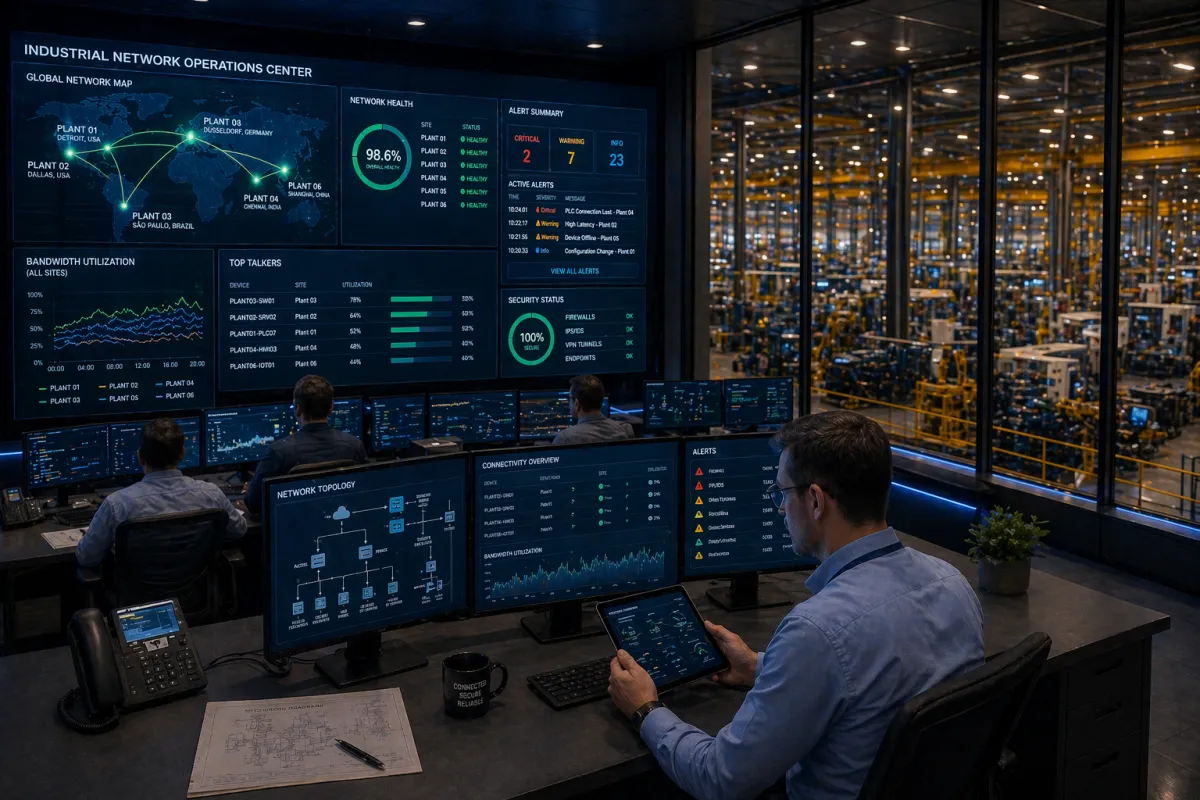
All sites are monitored from a centralized NOC platform that provides a single view of every location's network health, circuit status, device availability, and alert queue. Site-to-site connectivity status is monitored with alerting on circuit degradation and failover events, not just on complete outages.
Every network device at every site, including firewalls, core switches, distribution switches, and WAN edge devices, has an out-of-band management interface on a dedicated management VLAN that is accessible even when the primary network connection is disrupted. This is what allows a remote plant firewall that has lost its WAN connection to still be reachable for remote diagnosis and reconfiguration from the MSP's NOC.
24/7 remote monitoring and NOC services for manufacturing plants covering a managed network services multi-site manufacturing environment means the monitoring platform aggregates all site telemetry, alert escalation paths are defined per site, and the mean time to respond commitment applies to every location on the network, not just headquarters.
Layer 4: Standardized Site Builds for Consistency and Recovery Speed
Every remote plant in a well-managed multi-site manufacturing network is built from a standardized site architecture: the same firewall platform, the same switch stack configuration, the same management VLAN structure, and the same monitoring agent deployment. Standardization provides two benefits.
First, it makes remote management faster and more reliable. An engineer troubleshooting a network issue at a remote plant does not need to relearn a different configuration every time. The architecture is the same. The management interfaces are in the same places. Diagnosis and resolution are faster as a result.
Second, it makes hardware replacement faster. If a firewall at a remote plant fails, a pre-configured replacement unit can be shipped and installed by a local contact following a standardized procedure, without an MSP engineer traveling to the site. Standardization is the prerequisite for fast hardware swap recovery at remote locations.
How Manufacturing Companies Get Help Managing IT Across Multiple Plants
For multi-site manufacturers, the right approach to managing IT across locations is to work with an MSP that treats the entire network as a single managed environment rather than as a collection of separate site accounts.
A managed services provider delivering managed network services, multi-site manufacturing support takes ownership of the full network architecture: designing consistent site builds, managing the SD-WAN overlay, maintaining security zone consistency across locations, and providing centralized monitoring and NOC coverage for every site.
The practical process starts with a network assessment covering every facility. The assessment documents the current WAN topology, identifies inconsistencies in site security architecture, flags remote plants that lack out-of-band management infrastructure, and produces a remediation roadmap that brings all sites to a consistent, managed baseline.
From that baseline, the MSP operates the environment on a continuous basis: managing circuit failover events, responding to site-level alerts, handling firmware updates and configuration changes centrally, and providing the disaster recovery planning and business continuity frameworks that manufacturing IT depends on. These programs require a reliable, monitored network foundation.
Manufacturing IT directors who are managing multi-site networks without this foundation, relying on separate ISP contracts at each location, unmonitored switches that fail without notification, and site-level firewall configurations that have drifted from each other over years, are managing risk that compounds with every additional location added to the environment.
Multi-Site Networks Need Multi-Site Architecture
A manufacturer with five plants running on five separately managed, inconsistently configured networks does not have a multi-site network. It has five single-site networks with WAN links between them and no consistent security posture, no centralized visibility, and no reliable recovery path when any one of them fails.
Managed network services, multi-site manufacturing done correctly means a single coherent architecture across every location: consistent site builds, centralized monitoring, SD-WAN connectivity with automatic failover, and security zone design that protects OT environments at every plant, not just at headquarters.
The manufacturing IT security and managed services program that supports production operations across multiple facilities starts with the network. Everything else, including ERP access, SCADA security, disaster recovery, and 24/7 monitoring, depends on the network being designed, managed, and monitored as a unified environment.