EHR Downtime: What Healthcare Organizations Lose and How an MSP Prevents It
Most conversations about EHR downtime start with a dollar figure. Analysts calculate the cost per minute of lost productivity, delayed billing, and idle clinical staff. The number is real. It is also the wrong framing for how healthcare organizations should think about EHR outages.
When an EHR goes down, the cost is not primarily financial. It is operational and clinical. A nurse who cannot access a patient's medication history at the bedside does not have a productivity problem. She has a patient safety problem. A physician who cannot retrieve imaging results before a procedure does not have a revenue cycle problem. He has a care coordination problem. A front desk coordinator who cannot verify insurance eligibility does not have a billing inefficiency. She has a patient access problem that affects whether care gets delivered at all.
The financial cost of EHR downtime is a downstream consequence of clinical workflow disruption. Addressing EHR downtime as a financial problem, and measuring a managed IT provider's value in uptime percentages and cost-per-minute avoided, misses what healthcare organizations actually experience when a system goes down.
This guide addresses EHR downtime the right way: what clinical staff must actually do during an outage, what effective downtime procedures look like at the role level, and what an MSP must have in place to shorten both the frequency and duration of EHR outages.
Planned vs. Unplanned EHR Downtime: Two Different Problems
Not all EHR downtime is the same, and treating both types with the same response is one of the most common gaps in healthcare downtime planning.
Planned downtime is scheduled in advance by the EHR vendor or internal IT team for maintenance, upgrades, or infrastructure work. It is predictable, it can be communicated to staff in advance, and its duration is known within a reasonable range. Planned downtime causes disruption, but that disruption can be minimized through preparation: printing downtime materials in advance, scheduling the window during low-census periods, and briefing staff on the expected duration and restoration sequence.
Unplanned downtime is the outage nobody saw coming. A server crash, a database failure, a ransomware infection that reaches the EHR infrastructure, a network failure that cuts off access to a cloud-hosted system. Unplanned downtime arrives without warning and with no known restoration timeline. Staff who are mid-documentation when the system goes offline, patients who are mid-visit with no accessible record, and administrators who cannot generate claims or verify eligibility are all dealing with a situation they did not prepare for.
The response procedures for both types need to be documented before either type occurs. But the emphasis in most healthcare organizations' downtime planning needs to shift toward unplanned downtime, because that is the scenario where the absence of preparation produces the worst clinical outcomes.
What Clinical Staff Must Actually Do During an EHR Outage
This is the content gap that competitors have not addressed. Every MSP blog about EHR downtime describes it as a problem to solve. None of them describes what the clinical staff experience looks like from inside the outage.
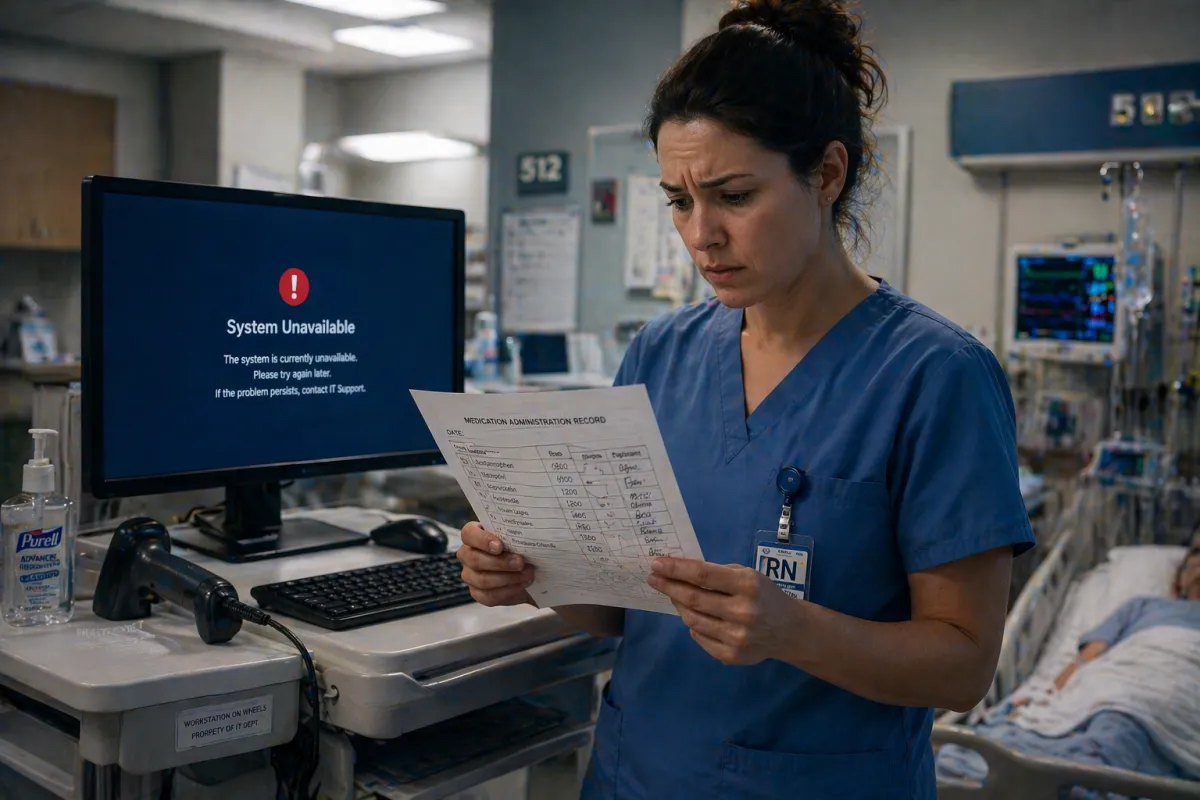
Nursing staff: The most immediate impact of an EHR outage for nursing is the loss of the electronic medication administration record (eMAR). Without access to the eMAR, nurses cannot confirm what medications are due, at what dose, or whether a medication has already been given on the current shift. The correct downtime procedure requires that printed downtime MARs be generated from the EHR before the system goes offline, or, for an unplanned outage, from the most recent printed copy that exists in the unit. If printed downtime MARs are not available, the nursing staff must reconstruct medication schedules from memory and verbal report, which is the highest-risk clinical scenario of any EHR downtime event.
Physicians and advanced practice providers: Loss of EHR access means loss of access to the problem list, medication history, allergy documentation, prior visit notes, and pending orders. Documentation of new encounters must shift to paper or voice recording, depending on the facility's downtime procedures. Orders must be communicated verbally or on paper, with a documented process for entering them into the EHR retroactively once the system is restored. The retroactive documentation window is a known quality and billing risk, orders placed on paper are frequently incomplete, missing required fields, or entered out of sequence.
Front desk and registration staff: Insurance eligibility verification, patient scheduling, and visit documentation all depend on EHR access. During a downtime event, registration staff typically default to manual registration forms, note-taking on paper, and deferred eligibility verification. The work that accumulates during the downtime window must be entered retroactively, creating a workload surge that extends the practical impact of the outage well beyond the restoration time.
Pharmacy and medication management: Pharmacies dependent on electronic order routing from the EHR face the same eMAR problem that nursing does, compounded by the risk of duplicate orders or missed cancellations when both paper and electronic orders exist in a transition period. Downtime procedures for the pharmacy must address how to manage the order queue upon restoration to prevent duplicate dispensing.
What Effective Downtime Procedures Look Like
Downtime procedures are not a binder on a shelf that gets opened when the system goes down. Effective downtime procedures are a set of role-specific, regularly tested workflows that allow clinical operations to continue safely without EHR access.
The components that every healthcare organization's downtime procedures must include:
Printed downtime reports: The EHR should be configured to generate a standard set of downtime reports on a defined schedule, including patient census with active medication lists, pending orders, allergy lists, and scheduled procedures. These reports need to be printed and distributed to clinical units at the start of every shift, before any outage occurs. An unplanned downtime event at 10 PM should not find a nursing unit without a patient list because the last printed downtime report was from 7 AM.
Role-specific paper documentation forms: Each role that documents in the EHR during normal operations needs a paper equivalent for downtime. These forms should mirror the data fields the role captures electronically, so that retroactive entry at restoration is straightforward rather than requiring interpretation of freehand notes.
Defined escalation contacts: Staff who discover an outage need a single, clear process for confirming that the system is down (rather than a local connectivity problem) and for reporting the outage to the correct contact. In a facility served by an MSP, that contact should be a 24/7 number that reaches a person, not a ticketing system queue.
Retroactive entry procedures: The window between system restoration and the return to normal workflow is high-risk. Retroactive entry of paper documentation into the EHR must follow a defined sequence that addresses order verification, duplicate check, and documentation completeness. This step is commonly under-documented.
Regular downtime drills: Clinical staff who have practiced paper-based workflows perform them significantly better during an actual outage than staff who have only read the procedure. Quarterly downtime drills, including having staff locate and use printed downtime reports under simulated conditions, are the practice that makes the procedures functional rather than theoretical.
How to Fix EHR Downtime in Healthcare
The short-term answer is clinical: activate downtime procedures, distribute printed materials, communicate to staff and patients about expected duration, and document everything for retroactive entry.
The long-term answer is infrastructure: the conditions that cause EHR downtime need to be identified and addressed before the next outage occurs.
Some infrastructure-related failures have warning signs that proactive monitoring may detect early:
Database performance degradation: EHR databases that are not regularly maintained, index fragmentation, statistics that have not been updated, transaction log files that have grown without management, become progressively slower, and eventually fail under load. Regular database maintenance on a defined schedule is an MSP service that directly prevents this category of outage.
Server resource exhaustion: EHR application servers that are running at high CPU or memory utilization under normal load have no capacity to handle spikes. Capacity monitoring that tracks utilization trends over time allows an MSP to identify servers that are approaching resource limits and address them before they fail.
Storage failures: Disk health degradation is detectable through SMART data and storage array monitoring well before a disk fails. An MSP monitoring storage health proactively replaces degrading drives during a planned maintenance window rather than during a clinical shift.
Network infrastructure failures: EHR systems that are cloud-hosted or accessed over a WAN are dependent on network infrastructure that can fail independently of the EHR application. Network monitoring that covers the full path from clinical workstations to the EHR, including switches, firewalls, and WAN links, detects network-layer failures before they affect clinical access.
Patch and update management: Unmanaged patch cycles leave EHR infrastructure servers vulnerable to failures caused by known software defects that vendor patches would have resolved. An MSP managing the patch cycle for EHR infrastructure servers applies updates during defined maintenance windows, with tested rollback procedures, rather than leaving servers on software versions with known stability issues.
What an MSP Must Have Ready for EHR Downtime Prevention
"EHR downtime prevention healthcare managed IT" is not a monitoring dashboard with a green status light. It is a set of specific capabilities that prevent downtime and shorten recovery when prevention fails.
The capabilities a healthcare-focused MSP must deliver include:
Proactive monitoring of EHR application servers, database servers, storage, and network infrastructure with defined alert thresholds that trigger a response before failures occur.
Database maintenance schedules for EHR database servers on a defined cadence, not vendor-default schedules that may not align with the usage patterns of the specific facility.
Uptime SLA commitments with defined recovery time objectives for EHR restoration, sized against the clinical operations reality of the facility rather than generic IT recovery benchmarks.
Out-of-band management access to critical servers so that a server that has lost its primary network connection is still reachable for remote diagnosis and remediation.
Downtime procedure support, including helping clinical leadership build and test printed downtime reports, define retroactive entry procedures, and conduct downtime drills that surface gaps before a real event.
"Managed IT services for EHR uptime and healthcare infrastructure" delivered by a partner with clinical environment experience means the technology program is designed around what an outage actually costs, not in dollars per minute, but in clinical workflow disruption, patient safety risk, and the operational burden on staff who are already working at capacity.
Prevention Is the Clinical Argument for MSP Investment
The case for "EHR downtime prevention healthcare managed IT" does not need to be made in financial terms. It needs to be made in clinical terms.
Every EHR outage that occurs during an active clinical shift is a period during which nurses are reconstructing medication schedules from memory, physicians are documenting on paper forms that will need to be re-entered, and front desk staff are manually tracking patient information that will require a retroactive entry workload surge at restoration.
That clinical reality, not the cost per minute, is the reason healthcare organizations need an MSP that monitors proactively, maintains infrastructure actively, and builds the downtime procedures that allow clinical operations to continue safely when the system is unavailable.
"Healthcare IT security and managed services" that treat EHR uptime as a clinical operations priority rather than an IT metric is the partnership that healthcare organizations need and most managed IT providers do not provide.