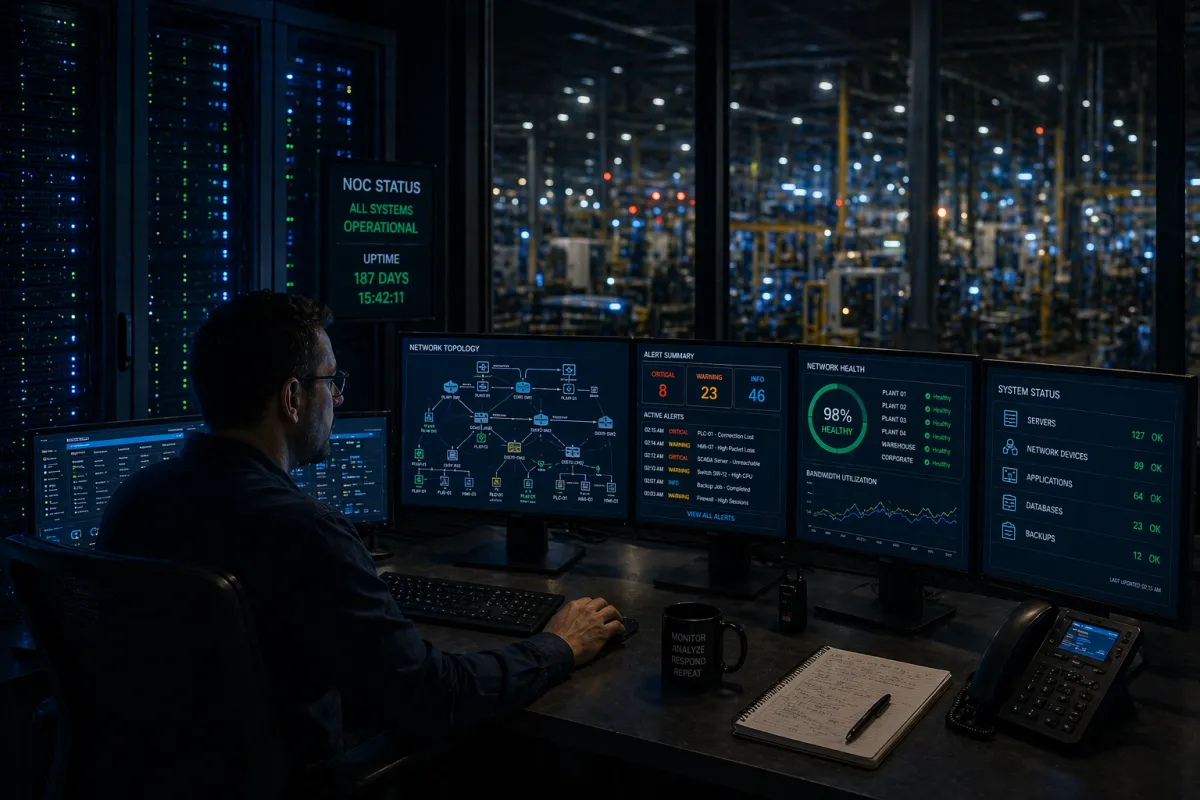
24/7 Remote Monitoring for Manufacturers: What Actually Happens When an Alert Fires
24/7 IT Monitoring for Manufacturing Plants: What Actually Happens When a Server Goes Down at 2 AM
Running a manufacturing plant means your operations never truly stop. Machines run overnight. Shifts rotate. Production targets don't wait for business hours. But when your IT infrastructure fails at 2 AM, and nobody is watching, the cost of that silence compounds fast.
That is why 24/7 IT monitoring for manufacturing plants has moved from a nice-to-have to an operational necessity. The question most plant managers and operations directors are asking now is not whether they need it, but what it actually looks like in practice.
This post breaks that down in plain terms, including exactly what happens inside a manufacturing NOC (Network Operations Center) when something goes wrong in the middle of the night.
What Is 24/7 IT Monitoring for a Manufacturing Plant?
24/7 IT monitoring for manufacturing plants refers to the continuous, around-the-clock oversight of your plant's entire IT environment. That includes servers, workstations, industrial control systems, network equipment, and the software that ties production together.
Unlike break-fix IT support, where someone calls a technician after something breaks, proactive monitoring catches problems before they stop production. A qualified managed service provider (MSP) uses Remote Monitoring and Management (RMM) tools to watch your systems in real time, 24 hours a day, 7 days a week, 365 days a year.
When an alert fires, a live technician in a Network Operations Center responds. Not a bot. Not a ticket queue that sits until morning. A person.
A Day in the Life of Your Manufacturing NOC: The 2 AM Server Failure
This is the scenario most IT vendors refuse to walk you through in detail. Here is what it actually looks like when your production server goes down at 2 AM.
2:04 AM: Your ERP server's CPU spikes past the threshold. The RMM platform detects the anomaly and fires an automated alert to the NOC.
2:05 AM: A NOC technician picks up the alert, reviews the telemetry data, and begins triage. They check connected systems, review recent patch activity, and look at error logs. This is where the mean time to respond (MTTR) is earned or lost.
2:09 AM: The technician identifies a runaway process tied to a scheduled batch job. They terminate the process remotely and monitor stabilization.
2:14 AM: Server performance normalizes. A ticket is created, documented, and flagged for root cause review in the morning. Your on-site team arrives at 6 AM to a full incident report already waiting in their inbox.
Total production impact: under 15 minutes. Without 24/7 monitoring, potentially the entire overnight shift.
That is the difference between a managed NOC and hoping your overnight staff notices something is wrong.
Why Uptime Is a Financial Issue, Not Just an IT Issue
Most manufacturers calculate downtime in terms of direct output loss. But the real cost is wider. A single hour of unplanned downtime in a mid-size manufacturing operation can cost anywhere from tens of thousands to hundreds of thousands of dollars when you factor in labor, missed orders, equipment wear from abnormal shutdowns, and customer penalties.
24/7 IT monitoring for manufacturing plants directly reduces the frequency and duration of unplanned downtime. Proactive monitoring with alert escalation protocols means problems are caught at the warning sign stage, not the failure stage.
Reputable MSPs offering round-the-clock IT monitoring for your manufacturing facility typically back their service with uptime guarantees, often targeting 99.9% or higher, with defined response time SLAs.
For plant managers, this is not an IT conversation. It is a production efficiency conversation.
What Gets Monitored in a Manufacturing Environment
A well-structured 24/7 IT monitoring program for a manufacturing plant covers more than basic servers. Here is what should be in scope:
Production servers and ERP systems: the core of scheduling, inventory, and order management
Network infrastructure: switches, firewalls, and connectivity between the shop floor and back office
Workstations and HMI terminals: devices directly tied to machine operation and operator input
Backup and disaster recovery systems: verifying that backups complete successfully and are restorable
Patch management: ensuring operating systems and software stay current without disrupting shift operations
Security event monitoring: detecting unauthorized access attempts, malware behavior, and ransomware indicators early
Manufacturers are increasingly targeted by ransomware because attackers know operational technology environments are harder to defend and the pressure to pay is high. Continuous security monitoring is now part of the core value proposition of 24/7 IT monitoring for manufacturing plants, not an add-on.
The Role of Predictive Maintenance in Modern Manufacturing IT
Traditional IT support is reactive. Proactive monitoring changes the model. But leading MSPs are going further by layering predictive maintenance capabilities into their RMM platforms.
Predictive maintenance in an IT context means using historical performance data to forecast failures before they occur. If a server's disk health has been degrading for over six weeks, a good NOC flags it for replacement during a scheduled maintenance window, not during a production run.
This ties directly into how manufacturers reduce unplanned downtime with managed IT by shifting from a reactive cost model to a planned investment model. You stop paying emergency rates for emergency fixes and start paying predictable monthly fees for preventive care.
How Do I Get 24/7 Remote Monitoring for My Manufacturing Company?
This is one of the most common questions plant managers and operations directors search for online. Here is a straightforward answer.
You get 24/7 IT monitoring for your manufacturing plant by partnering with a managed service provider that operates a dedicated NOC. Not every MSP does. Many outsource after-hours monitoring to third-party NOC services with no context about your environment. When evaluating providers, ask specifically:
Do you operate your own NOC or outsource it?
What is your documented mean time to respond to critical alerts?
How are alert escalations handled during overnight hours?
Do you have experience with manufacturing environments and industrial control systems?
What does your incident response documentation look like?
A provider worth working with will answer these questions with specifics, not generalities. They should be able to walk you through exactly what happens from the moment an alert fires to the moment your system is stabilized. If they cannot, that is a meaningful gap.
You should also ask about IT support options for manufacturing plants that go beyond monitoring alone, including help desk access, on-site support agreements, and strategic planning services. The best MSP relationships are not just about watching your systems. They are about understanding why manufacturing companies are switching to managed service providers and building a long-term technology roadmap that supports production goals.
What Separates Good 24/7 Monitoring From Basic Monitoring
A lot of managed IT providers claim 24/7 coverage. Fewer can show you what that actually means. Here is what to look for beyond the marketing language:
Documented incident response procedures: Can they show you a written playbook for how different alert types are handled?
Transparent SLA reporting: Do they provide monthly reports showing actual response times, incidents resolved, and uptime statistics?
NOC staffing model: Is the NOC staffed by trained technicians or by automated scripts with a human fallback that takes 45 minutes to respond?
Manufacturing-specific experience: Does the provider understand the difference between a standard office network and a production environment where a 10-minute reboot window has to be coordinated with a shift supervisor?
How patch management protects manufacturing operations is a good test question. A knowledgeable provider will explain not just what patch management does but also how they schedule updates to avoid conflicts with production shifts and how they test patches before deployment in an OT environment.
Manufacturing plants run on uptime. Every minute a production system is down is a minute of revenue, labor, and competitive position lost. 24/7 IT monitoring for manufacturing plants is no longer a luxury reserved for enterprise-scale operations. Mid-size manufacturers are implementing it because the math is simple: the cost of monitoring is a fraction of the cost of a single major incident.
The right managed service provider does not just watch your systems. They act on what they see, document everything they do, and give you the visibility to understand your IT environment as clearly as you understand your production line.
If your current IT support model has anyone hoping nothing goes wrong overnight, it is time to change the model.